
Values in Emery County Property Records
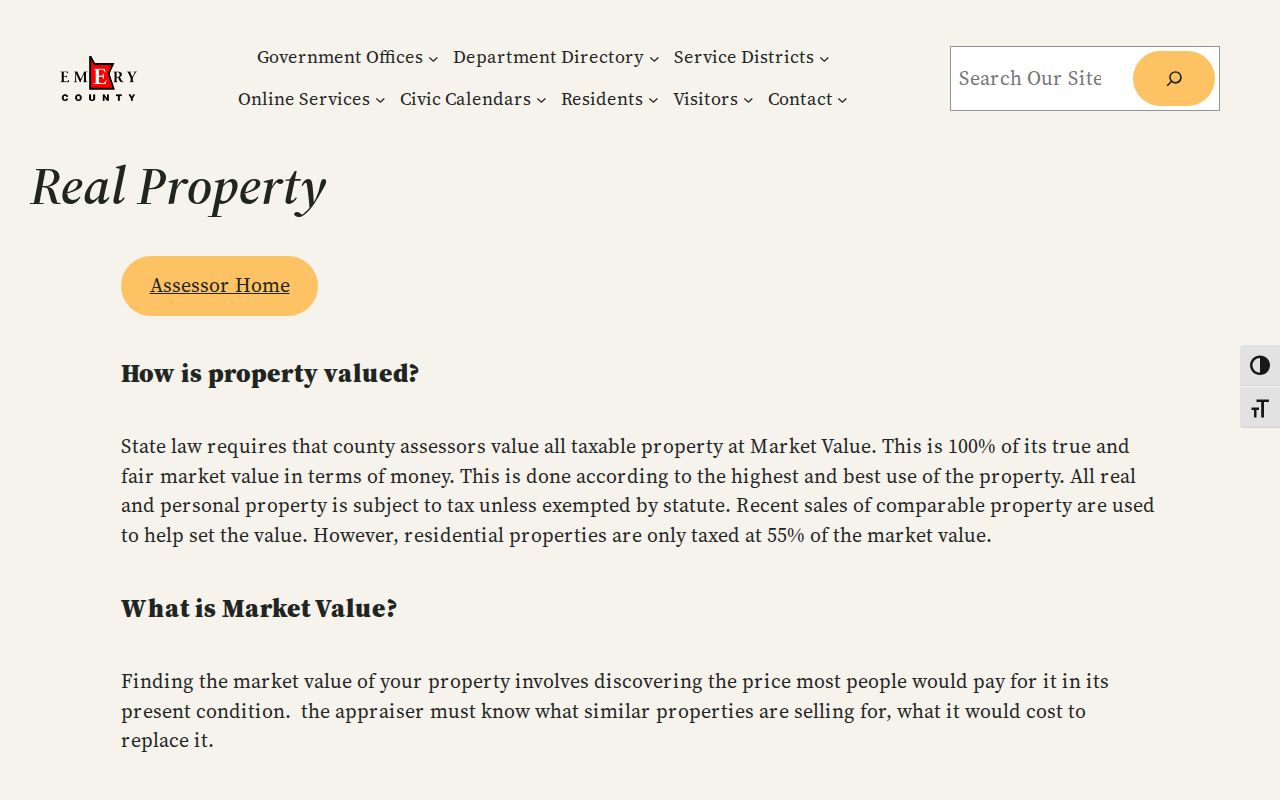
The Assessor's materials define market value plainly. It is the price two willing parties strike. The sale must be arm's length, and reasonable purchase costs stay out of the figure. Emery County relies on three approaches. Sales, income, and cost each weigh different evidence. A tax-roll row, though, is not a detailed property card in the public source, so it shows no land and building split, no last-sale field, and not every value entry. Keep the estimate separate from the tax notice and from any price written in a deed record.
| Value | What It Is | Where |
|---|---|---|
| Market value | Assessor's estimate of a current arm's-length exchange | Assessor valuation materials and notice |
| Residential taxable level | 55 percent of market value for residential property | Utah and county assessment rules |
| Taxable amount | Value used in the tax calculation after applicable treatment | Assessment and tax account records |
| Sale or consideration | Transaction amount, if shown in the relevant transfer record | Recorded instrument or transaction document |
Adjustments happen annually. Physical inspections run on a five-year cycle. A value can therefore reflect the year's market process even when the parcel was not physically inspected. Residential property is taxed at 55 percent. That taxable level of market value is not a prediction that a house will sell for 55 percent of a listed price. For tax bills, exemptions, or appeal steps, use the separate Emery County property tax records page.
Emery County Assessor Value Method
The Appraisal Division frames current market value the same way. Picture a willing buyer and seller in an arm's-length sale. Reasonable purchase costs stay out of the number. Three approaches feed the estimate. Sales comparison, income, and cost each draw on different evidence. A mass appraisal, though, cannot inspect every interior. It also cannot price every feature a private buyer would value. The county's figure is a tax-administration number tied to one parcel and one valuation date. A parcel map or plat can help confirm what the estimate covers.
The Assessor's public pages give the definition and process. The tax-roll sample links parcel, plat, and notice records. The value itself is not displayed there. A specific assessed figure may matter. Use the valuation notice or request the parcel's current assessment record from the Assessor. Never infer a value from a tax bill. Tax charges and valuation are different fields. The Emery County real-property assessment page explains the valuation definition and the evidence approaches.
Read the official definition before treating an assessment number as a guaranteed sale amount.
Emery County's January Valuation Date
January 1 is Emery County's assessment date. Values are adjusted each year. Inspections happen every five years. A figure can therefore reflect the year's market update even when nobody walked the property. Owners comparing years should read the date on each value and note whether it came from a full market update or a new inspection. The tax-roll page links notices for 2022 through 2025. The rows carry no value history. Nor do they show a last-sale date, and a current assessed figure beside an older sale price may point to different dates, conditions, or terms.
Parcels also change. A later document may split, combine, improve, or describe the land differently. Confirm the parcel serial and legal description first, and use the Assessor's landing page for appraisal and real-property links.

The linked resources explain the process. The parcel's own figure should come from its notice or assessment record.
Looking Up an Emery County Property Value
Start with the parcel serial. You can also use the address, or the owner of record label on the tax roll. The public sample gives a TaxRoll link and annual notices. No complete value-detail card appears. For the assessed number, use the current valuation notice. Or ask the Assessor which public record applies. Keep the year with the amount. An unlabeled number is hard to compare with anything. A mix of years only deepens the confusion.
- Match the parcel using its full serial and Property Address.
- Open the tax-roll account and notice links for the relevant year.
- Request the current valuation notice or assessment record from the Assessor if the value is not shown.
- Compare a sale amount only after checking that it concerns the same parcel and date range.
- Assessed value
- The value assigned by the Assessor for tax administration.
- Market value
- The county's current arm's-length value estimate.
- Residential taxable level
- Fifty-five percent of market value for residential property in Emery County.
- Sale price
- The amount in a transaction record, if captured there; it is not the assessment.
Emery County's Residential Taxable Level
Utah requires value at 100 percent of true and fair market value. Residential property is taxed at 55 percent. Those are separate stages. Market value is the Assessor's estimate, and the residential level sets the taxable basis. Neither is a second appraisal. The 55 percent of market value is not a discount on a home's sale price, and other account details that move a bill belong with the Treasurer and the tax notice.
Compare within the same class and year. A house, a condo unit, a commercial tract, and a rural parcel rarely share features or comparable sales. The public tax-roll sample shows no market value field. No land and improvement split or exemption detail appears either. Ask the Emery County Assessor for the parcel's current assessment record rather than plugging in a neighbor's tax amount.
Sale Price and Emery County Assessed Value
A deed and an assessment answer different questions in Emery County. The recorded transfer instrument names the parties and carries the legal description, and a sale or consideration figure may appear in that record. The public tax-roll row, though, shows no last-sale field. The Assessor's market value is something else entirely: a current estimate built from sales, income, and cost evidence. A private appraisal serves one client at one moment. So several numbers can sit side by side without any being wrong.
Comparison only works when the details line up. Confirm the same parcel number first. Match the date and property condition, since an acreage change, a subdivision amendment, or a new improvement can shift the picture. A tax-year value is not an offer price. A deed's consideration is not an appraisal substitute. For the recorded instrument itself, the Recorder's land-document page is the route.
Read the transfer instrument's legal description first. Then keep its transaction figure separate from the Assessor's value.
Emery County Value Notices and Requests
Value disputes follow a calendar in Emery County. The Assessor mails valuation notices and the Board of Equalization handles appeals, with a 45-day window that starts on the mailing date. The county says notices go out in July, while the state calendar lists June 22. Those published dates do not align exactly. So trust the date printed on your actual notice and confirm current directions with the county. The appeal mechanics belong on the tax-record page; this page is about reading the number.
Missing a figure or need a prior year? Contact the Assessor at (435) 381-3540 with the parcel serial, the assessment year, and the document you want. Ask about an electronic copy or an inspection. And get a fee estimate before staff begin research. Utah GRAMA requires public-record requests to describe the material with reasonable specificity. The county's online sample makes no promise of a searchable value field or export control. The Emery County property tax records page covers the bill and appeal steps. Value interpretation stays here.
What an Emery County Assessed Value Is Not
An Emery County assessed value is a tax figure. It comes from mass appraisal and is pinned to a stated valuation date. It is not a promised sale price. It is not a buyer's offer. Nor is it a mortgage appraisal, a structural inspection, or a boundary survey. The public tax-roll row stops short of a full parcel card. Getting the value itself may take a notice or a direct request to the Assessor.
Value vs price. Emery County's tax value does not say what a property will sell for. For a transaction decision, use a licensed appraiser and the appropriate parcel and sales evidence.