
The Emery County Owner-of-Record Row
The tax roll is the loudest current-owner signal Emery County publishes. Each row pairs a Primary Name and parcel serial with the Property Address, Address 1, city, state, ZIP, and plat. It also carries the master TaxRoll link and the annual notice links. That is real information. What the table leaves out matters too. There is no detailed assessor card, no last-sale date, and no land-and-improvement split. No instrument shows how the owner took title. Read the row as the name on today's tax account. Then confirm the recorded transfer with the Recorder when title actually counts.
| Primary Name | The owner label printed on the public tax-roll row |
|---|---|
| Parcel Number | The serial used to connect the tax account and plat |
| Property Address | The situs or rural location text for the parcel |
| Address 1 | The mailing address for tax notices, which may be a PO Box |
| Deed Reference | Not displayed in the tax-roll sample; ask the Recorder |
| Transfer date | Not shown in the public row; verify the latest recorded deed |
Parcel 01-0001-0011 makes the pattern plain. Its Primary Name reads JOHANSEN, CRAIG E TRUSTEE. The Property Address is E 1000 N: 15. Address 1 is a PO Box 487 in Castle Dale. Owner label, situs, and notice address sit in three separate fields. The row names no trust beneficiaries and says nothing about who lives on the land. Tax notices travel to the mailing address, not necessarily to the property itself.
Emery County Primary Name and Address Clues
That tax-roll example is instructive. It shows the distance between an owner label and a complete ownership file. A name may carry "TRUSTEE" or "LLC." The mailing line may point to a PO Box. Neither string reveals every person or interest behind the title. Keep the exact displayed text and the parcel handy. Keep the Property Address and Address 1 handy as well when asking the county to pull the related record.
The Treasurer's public tax-roll table lines those fields up. It also sits beside a plat and master account link.
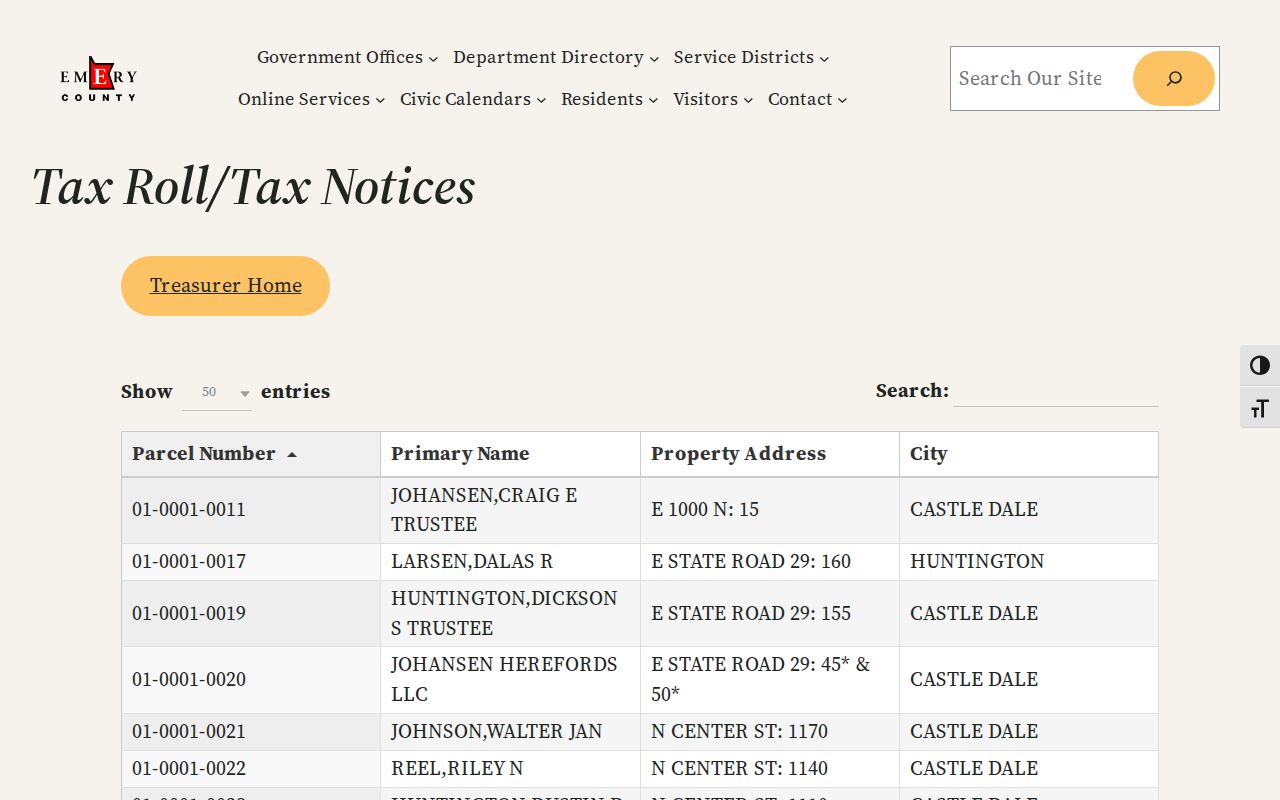
Treat the table as a way to spot a candidate owner-of-record row, never as a household or beneficiary roster.
How Current Is an Emery County Owner Row?
Emery County publishes no stated lag between a Recorder filing and an Assessor update. A deed can therefore be recorded while the tax-roll row still shows the prior owner. The two records answer different questions. The roll carries the current tax-account name. The deed is the filed transfer. When a closing is recent, do not judge the roll stale or current by guessing at days. Ask the Recorder whether the deed is indexed. Ask the Assessor or Treasurer when the account will catch up.
Whenever the names differ, work from the full parcel and legal description. A mailing-address change can also update on its own schedule. It moves apart from the transfer of title. Note the dates of any tax notice and deed copy used. Others can then see which records supported the conclusion. The latest recorded deed is the stronger evidence of a current transfer. A tax row by itself guarantees nothing about title.
Emery County Trust and LLC Owner Names
When the roll shows an LLC, Utah's Registered Entities Search takes a full or partial entity name plus an entity-type selection. Entity details may list principals and registered agents. That is business-record context, not a deed substitute. A registered agent is a contact point, not automatically the beneficial owner of the land. Likewise, a trustee label names no one who benefits from a trust.
The useful comparison is threefold. Check the entity name on the tax row, the grantee in the recorded deed, and the state entity record. A company may have changed names. An estate may hold title. In either case, the current legal instrument and any probate authority govern. Watch punctuation too, since the roll's uppercase display may not match the state's formatting.
The Utah Registered Entities Search handles the state-level entity lookup.
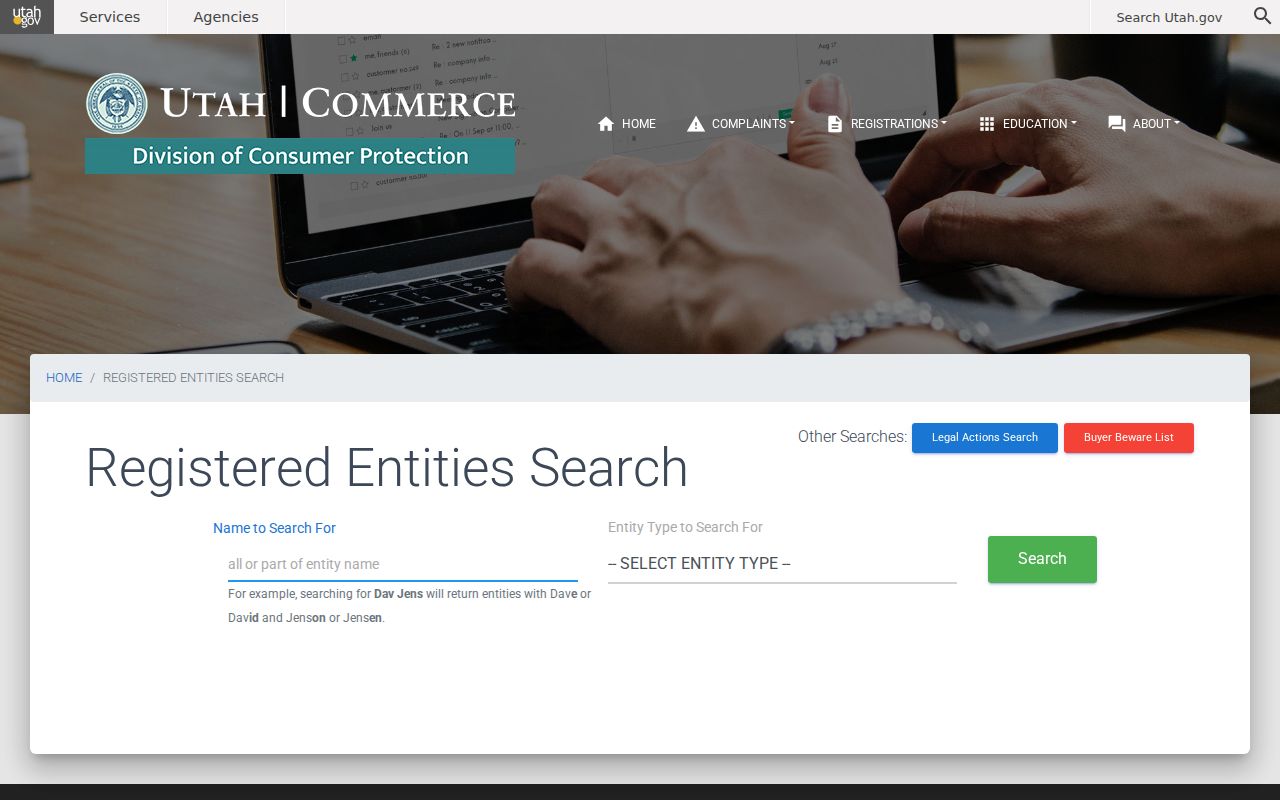
Let the state result explain the entity name. Then go back to the parcel's recorded deed for the actual land transfer.
Confirming the Current Emery County Owner
Confirming a current Emery County owner means matching the public row to the latest deed. That deed must affect the same legal description. The Recorder's public pages offer no documented online party-search form. Ask instead which index or book covers the deed date. Bring the parcel serial and the Primary Name. Include the subdivision or rural description and the date of the latest known transfer.
- Copy the tax-roll Primary Name, parcel serial, situs, and mailing address.
- Ask the Recorder for the newest transfer affecting the same legal description.
- Compare the grantee, vesting language, legal description, and recording date with the tax row.
- Use Utah's entity search only to clarify a company name, not to replace the deed.
- Owner of record
- The name shown by a particular record, such as the tax roll.
- Vesting
- The form in which an instrument names the grantee or entity.
- Registered agent
- A state's listed contact for a business entity.
- Recording lag
- The time between filing a deed and a separate tax account reflecting it; Emery County has not published a normal interval.
Requesting Emery County Owner Records
A deed or a detailed tax field may never make it online. Go straight to the office that keeps it. Recorder Josie Stilson works from 75 East Main Street in Castle Dale. Hours are weekdays from 8:30 a.m. to 5 p.m., except county holidays. Call (435) 381-3520 or write to recorder@emery.utah.gov. The Assessor sits at the county records hub and takes calls at (435) 381-3540. For tax-account details, the Treasurer is the right stop, at (435) 381-3530.
A GRAMA request works best with specifics. Name the parcel, the parties, the record type, and the date range. Say whether you want electronic inspection or a copy. The standard response is due within 10 business days. A qualifying public-interest request can shorten that to five. Fees may cover staff time, copies, media, and mailing. Ask for an estimate before any broad property records search. One caution applies. A protected-record classification or another law can still limit what gets released.
Emery County Government Names on the Roll
Not every name on the Emery County tax roll belongs to a household or a private company. Some rows show a government owner instead. The sample inventory mixes individual, trustee, and LLC names with a county courthouse parcel and Castle Dale City parcels. Read the Primary Name exactly as printed before you guess which office holds related permits or zoning files. Even a municipal owner label still runs through county tax and land records for the parcel.
That distinction matters when a public tract, road, courthouse lot, or city-owned parcel shows up on a GIS map. The tax roll tells you the name on the account. The Recorder and the GIS plat route can then pin down the legal description. A city office may answer a question about local use. But the county title record remains the authoritative source.
Using an Emery County Mailing Address
The mailing address on an Emery County tax roll is the right channel for a lawful, property-related notice or inquiry. Treat it as nothing more. It does not prove where anyone lives. Utah's Safe at Home program gives eligible protected participants a substitute address, and that address should never be mistaken for an ordinary property situs or residence. Court files and other protected records can further limit what the public sees.
Lawful use. Emery County owner information is for property research and legitimate property matters. Do not use a mailing address or name to stalk, threaten, intimidate, or harm anyone; respect protected addresses and contact the custodian if a record raises a privacy question.