
What Emery County Property Tax Records Show
The Treasurer publishes a public tax-roll table. Each row carries a parcel number, a Primary Name, Property Address, Address 1, city, state, and ZIP. It also links to a plat, a master TaxRoll entry, and annual tax notices running 2025 back to 2022. The Assessor covers market value and appeals on its own pages. What the table does not show is an interactive owner or address query. The visible sample also omits market value. It leaves out the split of land and improvement values, and any deed reference.
| Field | What It Shows | Where |
|---|---|---|
| Parcel and Primary Name | Tax account key and displayed owner label | Treasurer tax-roll table |
| Property Address | Situs or rural address text | Tax-roll row |
| Address 1, City, State, Zip | Notice-mailing fields, which may differ from situs | Tax-roll row |
| Plat and TaxRoll links | Recorded map and master tax account | Tax-roll row |
| Tax 2025, 2024, 2023, 2022 | Annual notice links for the listed years | Treasurer tax-roll table |
How does the Assessor define value? It is the price a willing buyer and a willing seller would strike in an arm's-length deal, with reasonable purchase costs set aside. Sales, income, and cost approaches all feed the number. Residential property is taxed at 55 percent of market value. That tax level is not a sale estimate. The Emery County property value discussion unpacks what value means in more depth.
Emery County Tax-Roll Links by Parcel
Start with the full parcel number when you have it. The tax-roll row links to a plat. It also links to a master tax record, and a separate notice appears for each year. Addresses are trickier. Property Address text may be rural or abbreviated. Address 1 can be a PO Box. A Castle Dale situs may carry a mailing address somewhere else entirely. Compare the parcel and legal description before trusting a match. The tax roll is a published table, not a query form. The Treasurer's page offers no owner filter, result limit, export control, or online payment-status search. Treat each visible row as a directory of account links. A tax year or account detail may be missing. Call the Treasurer at (435) 381-3530 with the parcel serial in hand. The Emery County tax-roll page lays out its parcel, name, address, and annual notice columns.
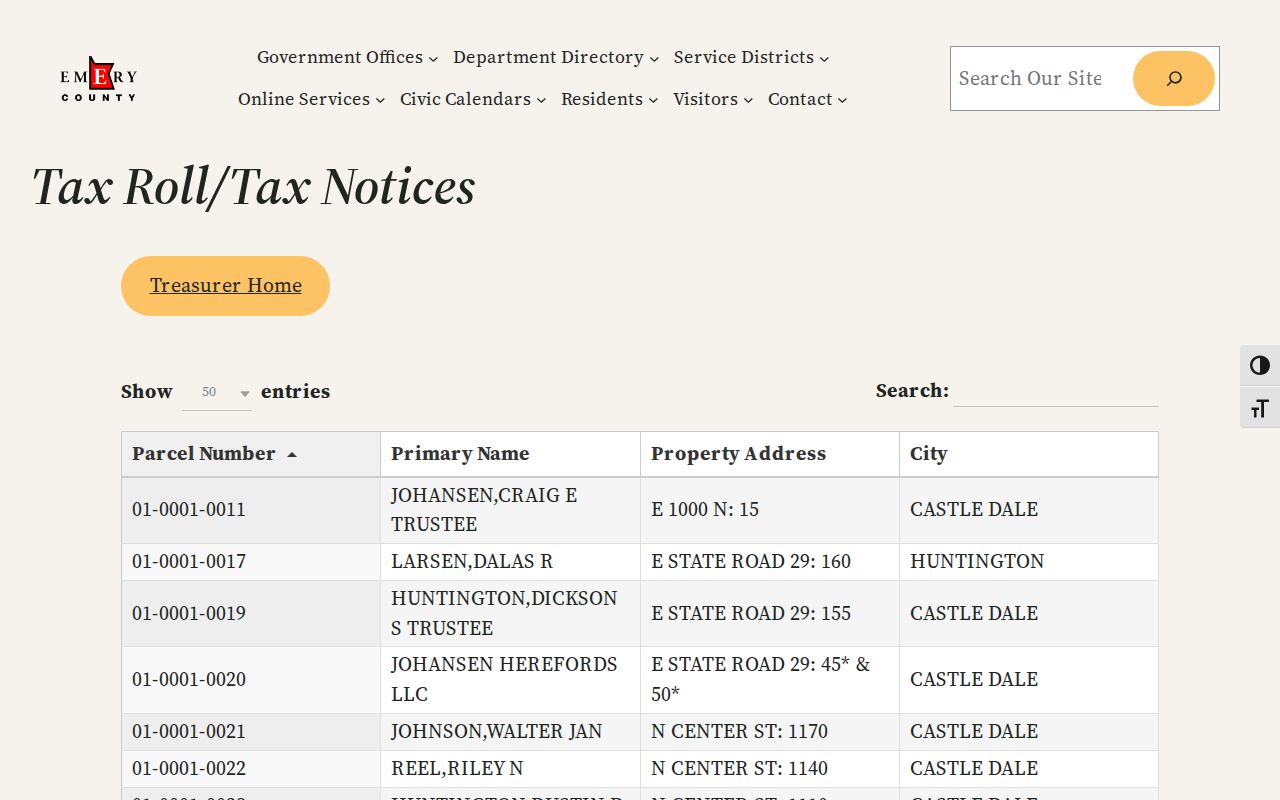
A sample row links the parcel to its annual notices and the master account record. The Emery County Assessor page connects to valuation and real-property materials.

Read the Assessor's figures to understand the value. Read the Treasurer's notice for the billed account.
Emery County Assessment Cycle
January 1 is the lien and valuation date. Every year, Emery County adjusts all property to market value. Each parcel gets a physical inspection on a five-year cycle. So an assessment can shift from the annual update alone. No field visit is needed for that. Residential property is taxed at 55 percent of market value. Read a notice and an assessment record together to see which value was used. They also show when a review can be requested. The Assessor's appraisal materials describe three approaches: sales comparison, income, and cost. Which evidence matters depends on the parcel. A recent sale may weigh more for one property. Income history or construction cost may matter more for another. The 55 percent residential level is not a forecast of a sale price. A real tax bill also reflects charges and account status. The linked notice and master record help explain that. The Assessor's real-property page walks through value, annual adjustment, physical inspection, and appeals.
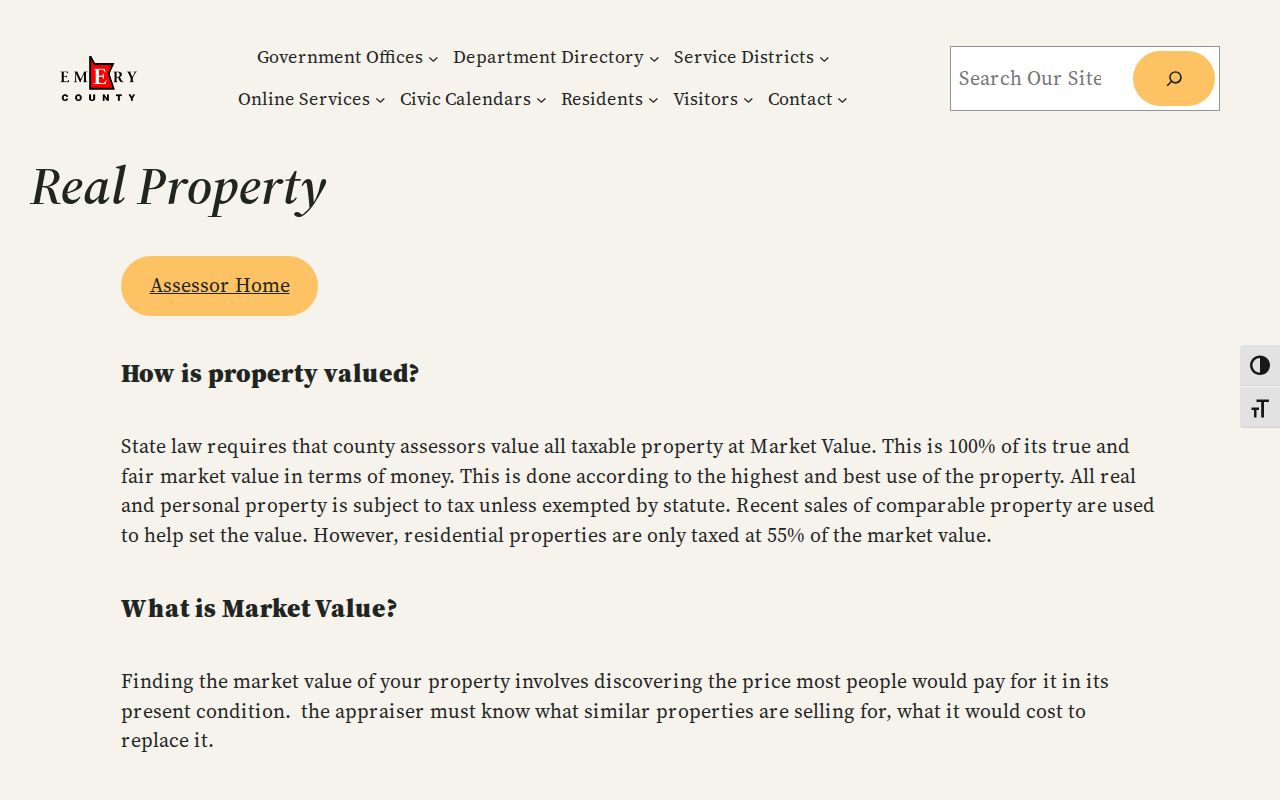
Keep the assessed figure separate from a sale price or a private appraisal when reviewing the account.
Opening an Emery County Tax Bill
A single tax-roll row can lead to a notice for each displayed year. It also leads to the master tax record. Reach for the parcel serial first. Street text may be rural or abbreviated. The notice is the document for one tax year. The master record supplies the account context around it. Payment or delinquency status may not be obvious from the public row. Confirm the live account with the Treasurer before reading a notice as an unpaid balance.
- Identify the parcel in the tax-roll table or ask the Assessor to help match an address.
- Open the TaxRoll master record and the annual notice for the year under review.
- Compare the parcel, displayed name, situs, and mailing address across the row.
- Contact the Treasurer for current payment, delinquency, or redemption status.
- Market value
- The Assessor's estimate of value in an arm's-length transaction.
- Taxable level
- The portion or basis used to calculate tax; Emery residential property uses 55 percent of market value.
- Tax notice
- The annual bill document linked from a tax-roll row.
- Tax lien
- A claim tied to unpaid property taxes, with status confirmed by the Treasurer.
Emery County Notice and Appeal Dates
Emery County's own calendar says valuation notices go out in July. The state calendar, though, lists June 22 as the notice-of-valuation date. That mismatch matters. Appeals are due within 45 days of mailing. So the clock starts on the date printed on the actual notice, not on either calendar page. If a notice arrives late, never shows up, or reads unclearly, the Assessor's office is the place to call. Treat the calendar as a rough map and the notice as the road.
An appeal goes to the county Board of Equalization. The Assessor's materials suggest an appraisal for the hearing. They also suggest a closing statement or comparable sales. Whatever you present should speak to the specific parcel and its valuation date. Filing the paperwork is one thing. Winning a value change is another. The Board's page opens the route without promising an outcome. Hold onto copies of the notice and every supporting document you submit.
The Emery County assessment calendar posts the county's tax and appeal dates.
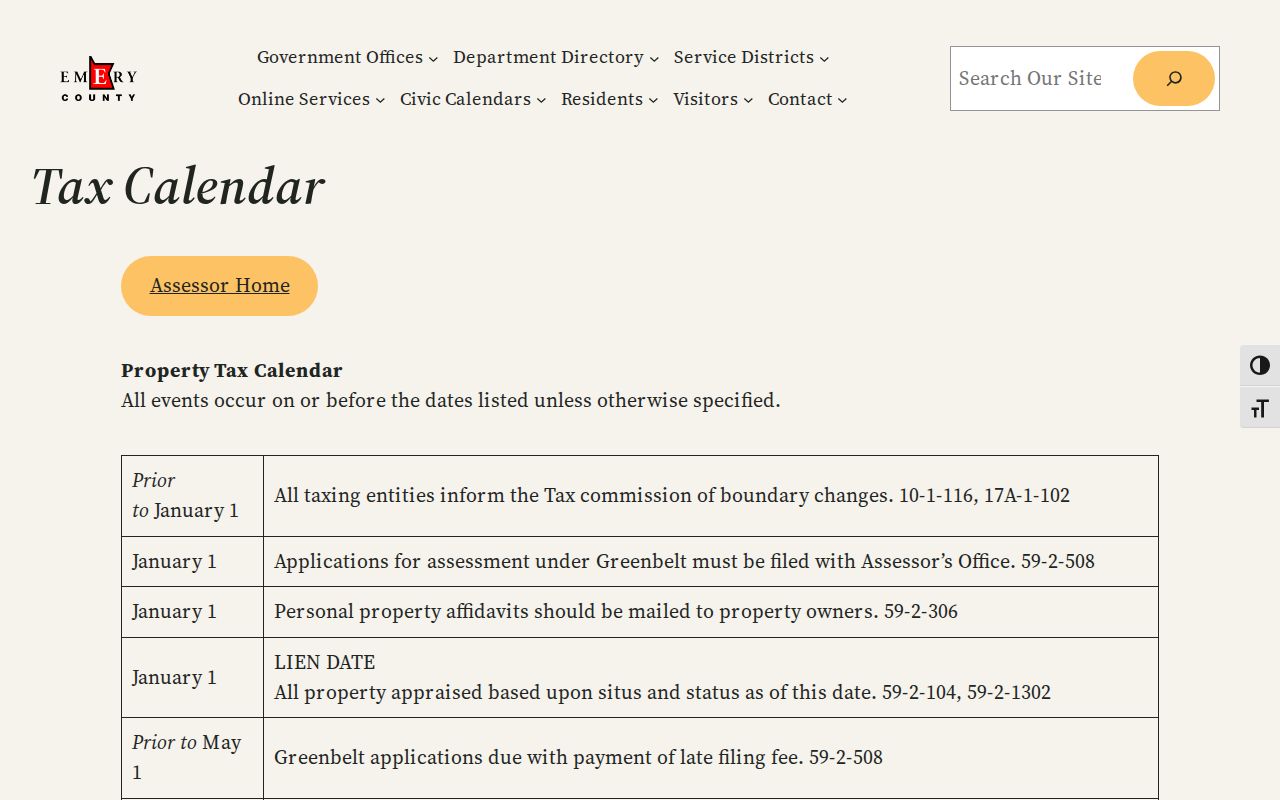
Let the calendar guide your planning. Count the 45-day appeal window from the mailing date on the notice itself, and use the county's Board of Equalization page to enter the local review process.
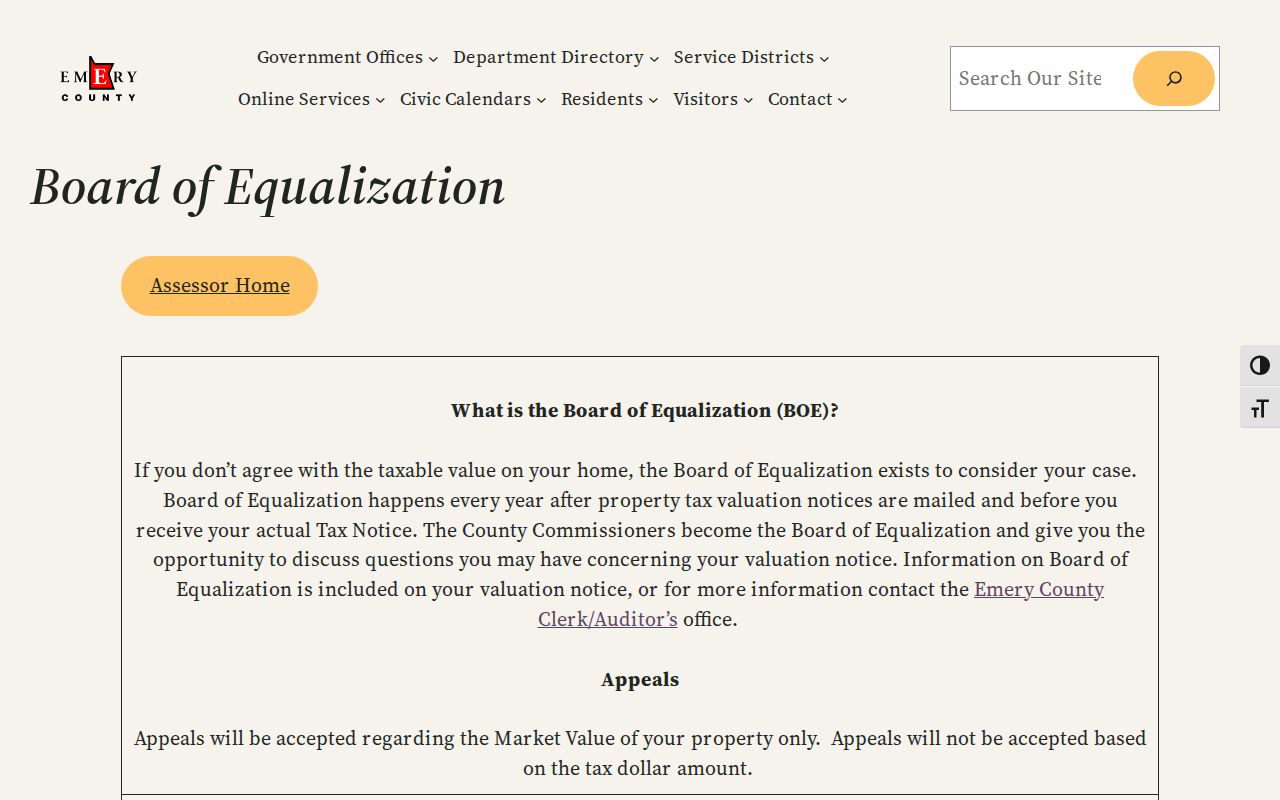
The Board page starts the review; the mailed notice still fixes the real deadline.
Emery County Delinquency and Tax Sales
Emery County's tax-sale page publishes notices for delinquent real property. One recent notice covered a 2026 auction. It scheduled the sale for May 21 at 9 a.m. on the courthouse front steps in Emery County. Each listed parcel came with owner, address, parcel serial, and legal description. At least one row carried a "REDEEMED" mark. That is the practical warning: a posted list can lag a parcel's true standing. Before acting on any line, confirm current status with the Treasurer or the Clerk/Auditor.
Redemption is possible before sale. The county procedure requires payment of the delinquent tax plus interest, penalties, and administrative costs. It also spells out how payments apply, how to protest, and when a parcel can be withdrawn. November 30 is the usual delinquency date, and it triggers a 2 percent penalty. A county extension can push the date to December 20, though. A published notice does not prove the property sold. Nor does it prove a deed reached the Recorder. Check the final outcome and any recorded instrument before drawing conclusions.
The Emery County tax-sale notice carries the parcel details and auction information.
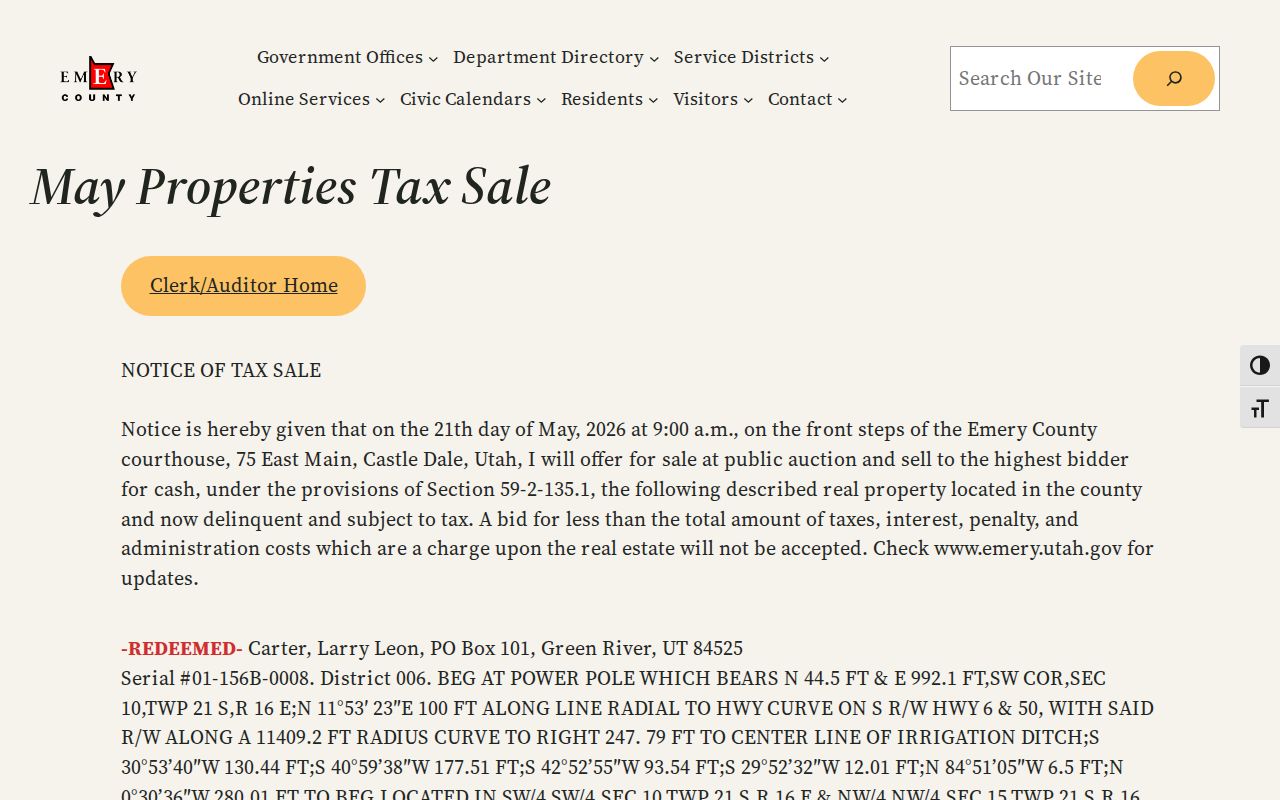
Read the posted notice alongside the written procedure. Ask the Treasurer directly about redemption or payment status, and use the tax-sale procedure PDF for the county's redemption and payment rules.
Requesting Emery County Tax Records
A year or a detail may be missing from the portal. Call the Treasurer at (435) 381-3530 or the Assessor at (435) 381-3540. Have the full parcel number ready. State the tax years, the record's name, and whether you want inspection or copies. Emery County also lists the Clerk/Auditor at (435) 381-3550 for administrative and tax-sale records. A narrow, written request helps the custodian pull the right account history quickly.
Utah's GRMA-style records law, GRAMA, governs these requests. A proper request identifies the public record with reasonable specificity. It also gives staff a way to reply or deliver it. Split assessment history, annual bills, permit records, and tax-sale files into separate requests. Do this when different offices hold them. Ask for electronic copies where offered. Request a cost estimate before staff begin research. Remember that records can be classified private, protected, or otherwise restricted. Access turns on the record itself, not merely its subject.
Before hunting a tax bill, pin down the parcel. The Emery County property search approach works. Keeping the situs, the mailing address, and the parcel serial straight saves time.
Appealing an Emery County Assessment
Start with the valuation notice. Contesting an Emery County assessed value means following the steps in that notice. Check with the Assessor or Board of Equalization for current instructions. The county relies on annual market adjustments and five-year physical inspections. Appeals must be filed within a 45-day window. That window is measured from mailing. Timing is the trap here. The website and the calendar describe mailing timing differently. So the actual mailed notice is the only safe deadline reference.
Appeal window. File within 45 days after the valuation notice is mailed, using the date on that notice. Emery County's Board of Equalization is the local appeal route; check its current directions and assemble evidence such as an appraisal, closing statement, or comparable sale information.